After Supplement I, we read John K. Hunter, Notes on Partial Differential Equations, Sections 3.1–3.6 and 4.1. The central construction is to move a derivative from a rough function onto a smooth test function by integration by parts. The resulting identity depends only on the almost-everywhere class of the original function. Our main examples will distinguish a corner, which admits an integrable weak derivative, from a jump, whose distributional derivative is a point mass.
1. Why weaken the derivative?
Let $\Omega\subseteq\mathbb R^n$ be an open set, where the positive integer $n$ is the dimension of the ambient Euclidean space. A classical derivative is defined by a pointwise limit. This is too rigid for many functions that arise as limits of smooth approximations or as solutions of partial differential equations.
The function
$$ u(x)=|x|\qquad(-1<x<1) $$is not classically differentiable at $x=0$, but it has a natural derivative in the sense that
$$ u'(x)= \begin{cases} -1,&x<0,\\ 1,&x>0. \end{cases} $$The missing value at $0$ does not matter for integration: a single point has Lebesgue measure $0$. This suggests an integral definition of differentiation. It does not justify merely ignoring every point where classical differentiation fails; the jump example below will show why that inference is false. Throughout, $dx$ denotes Lebesgue measure, and $L^p(\Omega)$ identifies functions that agree a.e.
2. Test functions
Write
$$ C_c^\infty(\Omega) $$for the space of infinitely differentiable functions $\varphi:\Omega\to\mathbb R$ whose support is compact and contained in $\Omega$. The support is
$$ \operatorname{supp}\varphi=\overline{\lbrace x\in\Omega:\varphi(x)\neq0\rbrace}. $$The overline denotes closure in $\mathbb R^n$. Compact support contained in $\Omega$ means that the nonzero part stays away from the boundary, so boundary terms disappear when we integrate by parts. The subscript $c$ means compact support and the superscript $\infty$ means smoothness of all orders. In one dimension, an example is $\varphi(x)=\exp(-1/(1-x^2))$ for $|x|<1$ and $\varphi(x)=0$ for $|x|\geq1$, considered on $\mathbb R$.
For a multi-index $\alpha=(\alpha_1,\ldots,\alpha_n)\in\mathbb N_0^n$, define
$$ |\alpha|=\alpha_1+\cdots+\alpha_n, \qquad \partial^\alpha =\frac{\partial^{|\alpha|}} {\partial x_1^{\alpha_1}\cdots\partial x_n^{\alpha_n}}. $$Here $\mathbb N_0=\{0,1,2,\ldots\}$ and $|\alpha|$ is the total order of the derivative. For example, $\alpha=(2,1)$ gives $\partial^\alpha u=\partial_{x_1}^2\partial_{x_2}u$. The zero multi-index denotes $u$ itself.
3. Distributions and weak derivatives
A distribution on $\Omega$ assigns a real number linearly and continuously to each test function. For this definition, $\varphi_j\to\varphi$ means that all supports lie in one compact subset of $\Omega$, and every derivative $\partial^\alpha\varphi_j$ converges uniformly to $\partial^\alpha\varphi$. Continuity requires that the assigned numbers converge as well. We write the action as
$$ \langle T,\varphi\rangle. $$The brackets denote application of a functional, not an inner product. A function belongs to $L^1_{\mathrm{loc}}(\Omega)$ if $\int_K|u|\;dx<\infty$ for every compact subset $K\subset\Omega$. Every such function defines a distribution $T_u$ by
$$ \langle T_u,\varphi\rangle =\int_\Omega u(x)\varphi(x)\;dx. $$The distributional derivative is defined by moving the derivative onto the test function:
$$ \langle \partial^\alpha T,\varphi\rangle =(-1)^{|\alpha|}\langle T,\partial^\alpha\varphi\rangle. $$If there is a function $v\in L^1_{\mathrm{loc}}(\Omega)$ such that
$$ \int_\Omega v\varphi\;dx =(-1)^{|\alpha|}\int_\Omega u\;\partial^\alpha\varphi\;dx \qquad\text{for every }\varphi\in C_c^\infty(\Omega), $$then $v$ is called the weak derivative $\partial^\alpha u$.
Every distribution has derivatives by this definition; a weak derivative as a function exists only when the distributional derivative can be represented by a locally integrable function $v$. Such a $v$ is unique a.e. If $u$ is smooth, ordinary integration by parts gives exactly this identity, so weak derivatives extend classical derivatives.
The corner $u(x)=|x|$. For $\varphi\in C_c^\infty((-1,1))$, split the integral at $0$ and integrate by parts: $$-\int_{-1}^1|x|\varphi'(x)\;dx =-\int_{-1}^0\varphi(x)\;dx+\int_0^1\varphi(x)\;dx.$$ The endpoint terms vanish: $\varphi$ vanishes near $-1$ and $1$, and $|x|$ vanishes at $0$. Thus the weak derivative is $\operatorname{sgn}(x)$, equal to $-1$ for $x<0$ and $1$ for $x>0$. Its value at $0$ may be chosen arbitrarily. Both $u$ and its weak derivative are bounded on this interval, so $u\in W^{1,p}((-1,1))$ for every $1\leq p\leq\infty$.
Now let $h(x)=\mathbf 1_{(0,1)}(x)$ on $(-1,1)$. Its classical derivative is $0$ except at $0$, but
$$ -\int_{-1}^1h(x)\varphi'(x)\;dx =-\int_0^1\varphi'(x)\;dx=\varphi(0). $$The map $\delta_0:\varphi\mapsto\varphi(0)$ is the Dirac distribution at $0$. It cannot be represented by a locally integrable function. Indeed, suppose $v$ represented it. Choose $\varphi_j(x)=\eta(jx)$, where $\eta$ is a smooth function supported in $(-1,1)$ with $0\leq\eta\leq1$ and $\eta(0)=1$. Then $\int v\varphi_j\;dx=1$, whereas $|\int v\varphi_j\;dx|\leq\int_{-1/j}^{1/j}|v|\;dx\to0$, a contradiction. Thus $h$ has distributional derivative $\delta_0$, but no weak derivative in $L^1_{\mathrm{loc}}$; in particular $h\notin W^{1,p}((-1,1))$. This is Hunter’s Example 3.4 restricted to our interval.
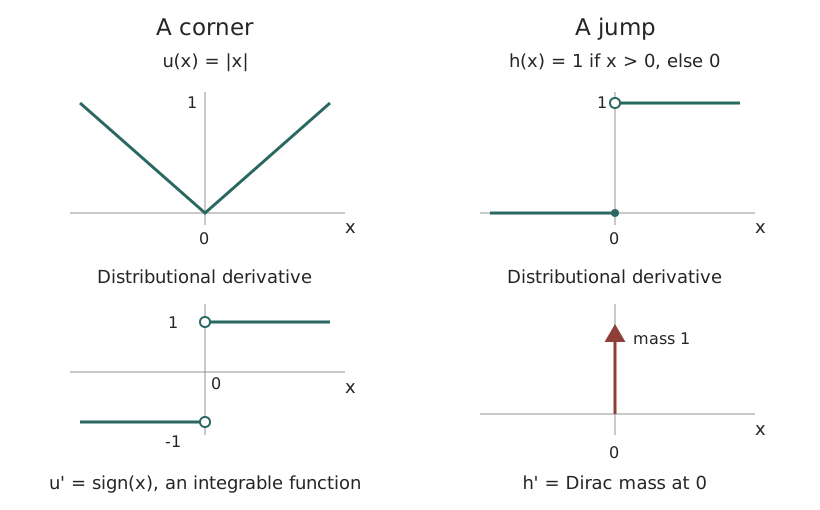
Our diagram, following the distinction in Hunter's Examples 3.3--3.4. Both classical derivatives fail only at the origin. Read the lower panels as distributions: the corner gives the integrable function sign(x); the jump gives a point mass, drawn as an arrow of mass 1.
4. Sobolev spaces
For $1\leq p\leq\infty$ and an integer $k\geq0$, define
$$ W^{k,p}(\Omega) =\left\{u\in L^p(\Omega): \partial^\alpha u\in L^p(\Omega)\text{ for every }|\alpha|\leq k\right\}, $$where every derivative is understood in the weak sense. A standard norm is
$$ \lVert u\rVert_{W^{k,p}} =\left(\sum_{|\alpha|\leq k} \lVert\partial^\alpha u\rVert_p^p\right)^{1/p} \qquad(1\leq p<\infty). $$For $p=\infty$, replace the sum by the maximum of the corresponding $L^\infty$ norms. The space
$$ H^k(\Omega)=W^{k,2}(\Omega) $$is the Hilbert-space case. In particular,
$$ H^1(\Omega)=\{u\in L^2(\Omega):\partial_{x_j}u\in L^2(\Omega),\ 1\leq j\leq n\}. $$Here $\nabla u=(\partial_{x_1}u,\ldots,\partial_{x_n}u)$ is the weak gradient. It is an $L^2$ vector field even when $u$ has no pointwise gradient everywhere. These Sobolev spaces are complete. For $p=2$, the inner product is the sum of $L^2$ inner products of derivatives up to order $k$; for $k=1$ it is $\int_\Omega(uv+\nabla u\cdot\nabla v)\;dx$. The dot is the Euclidean inner product of vectors.
For $1\leq p<\infty$, we also need
$$ W_0^{1,p}(\Omega)=\overline{C_c^\infty(\Omega)}^{\,W^{1,p}(\Omega)}, \qquad H_0^1(\Omega)=W_0^{1,2}(\Omega). $$The overline now means closure in the indicated norm: every element is a limit in $W^{1,p}$ of compactly supported smooth functions. On a Lipschitz domain, these are precisely the functions with zero boundary trace. A Lipschitz domain has a boundary locally represented, after rotation, as the graph of a Lipschitz function. A trace extends the boundary values of smooth functions continuously to Sobolev functions; it is not obtained by assigning arbitrary values on the measure-zero boundary.
5. Smooth approximation by mollifiers
Work first on all of $\mathbb R^n$. Choose a nonnegative function $\rho\in C_c^\infty(\mathbb R^n)$ supported in the unit ball, with
$$ \int_{\mathbb R^n}\rho(x)\;dx=1. $$For $\varepsilon>0$, set
$$ \rho_\varepsilon(x)=\varepsilon^{-n}\rho(x/\varepsilon). $$The mollification of $u$ is the convolution
$$ u_\varepsilon(x)=(u*\rho_\varepsilon)(x) =\int_{\mathbb R^n}u(x-y)\rho_\varepsilon(y)\;dy. $$For $u\in W^{k,p}(\mathbb R^n)$ with $1\leq p<\infty$, the function $u_\varepsilon$ is smooth and
$$ \partial^\alpha u_\varepsilon =(\partial^\alpha u)*\rho_\varepsilon. $$Moreover $\lVert u_\varepsilon-u\rVert_{W^{k,p}(\mathbb R^n)}\to0$ as $\varepsilon\downarrow0$. Thus both the function and its weak derivatives are approximated in the same norm. On a general open set the convolution is defined directly only where the distance to the boundary exceeds $\varepsilon$; global approximation needs additional work with cutoffs or an extension. We do not assume that zero extension across an arbitrary boundary preserves Sobolev regularity.
6. Poincare’s inequality
Let $\Omega$ be a bounded connected Lipschitz domain and let $1\leq p<\infty$. If
$$ u_\Omega=\frac1{|\Omega|}\int_\Omega u(x)\;dx $$is the average of $u$, where $|\Omega|=\int_\Omega1\;dx$ is its volume, then Poincare’s inequality gives
$$ \lVert u-u_\Omega\rVert_{L^p(\Omega)} \leq C\lVert\nabla u\rVert_{L^p(\Omega)} \qquad(u\in W^{1,p}(\Omega)). $$The constant $C$ depends on $\Omega$ and $p$, not on $u$. Subtracting the average is necessary because constant functions have zero gradient. For functions in $W_0^{1,p}(\Omega)$, the boundary condition removes this ambiguity and one obtains
$$ \lVert u\rVert_{L^p(\Omega)} \leq C\lVert\nabla u\rVert_{L^p(\Omega)}. $$On $(0,1)$ this estimate has a short proof. For a smooth function with $u(0)=0$, $u(x)=\int_0^xu'(t)\;dt$, so $|u(x)|\leq\int_0^1|u'(t)|\;dt\leq\lVert u'\rVert_p$ by Holder’s inequality. Integrating $|u(x)|^p$ over the unit interval gives $\lVert u\rVert_p\leq\lVert u'\rVert_p$. Approximation extends the inequality to $W_0^{1,p}(0,1)$. This is the estimate that will make gradient energy control the entire $H_0^1$ norm.
7. Sobolev embedding
Assume $1\leq p<n$ and define the critical exponent
$$ p^*=\frac{np}{n-p}. $$If $\Omega$ is a bounded Lipschitz domain,
$$ W^{1,p}(\Omega)\hookrightarrow L^{p^*}(\Omega), $$which means that every $W^{1,p}$ function belongs to $L^{p^*}$ and
$$ \lVert u\rVert_{L^{p^*}(\Omega)} \leq C\lVert u\rVert_{W^{1,p}(\Omega)}. $$Here $\hookrightarrow$ means continuous inclusion, quantified by the displayed estimate; it does not mean a compact inclusion. The exponent is forced by scaling: for $u_r(x)=u(rx)$ on $\mathbb R^n$, $\lVert u_r\rVert_q=r^{-n/q}\lVert u\rVert_q$ and $\lVert\nabla u_r\rVert_p=r^{1-n/p}\lVert\nabla u\rVert_p$. A bound $\lVert u\rVert_q\leq C\lVert\nabla u\rVert_p$ for all compactly supported smooth functions and all $r>0$ requires $-n/q=1-n/p$, hence $q=p^*$. This is Hunter’s scaling argument in Section 3.7.
For instance, $W^{1,2}$ embeds into $L^6$ in dimension $3$. For $n\geq2$ and $p=n$, the same bounded-domain hypotheses give inclusion in every finite $L^q$, but generally not $L^\infty$. For $n<p<\infty$, Morrey’s inequality gives a representative that is Holder continuous with exponent $1-n/p$. These are different conclusions; the formula for $p^*$ applies only when $p<n$.
8. Weak formulations
Let $\Omega$ be a bounded Lipschitz domain. Consider the Dirichlet problem
$$ -\Delta u=f\quad\text{in }\Omega, \qquad u=0\quad\text{on }\partial\Omega. $$Here $\Delta u=\sum_{j=1}^n\partial_{x_j}^2u$ is the Laplacian, $\partial\Omega$ is the boundary, and $f$ is the prescribed source. For a smooth solution and $\varphi\in C_c^\infty(\Omega)$, multiply by $\varphi$ and integrate:
$$ \int_\Omega(-\Delta u)\varphi\;dx =\int_\Omega f\varphi\;dx. $$When $f\in L^2(\Omega)$, integration by parts gives
$$ \int_\Omega\nabla u\cdot\nabla\varphi\;dx =\int_\Omega f\varphi\;dx. $$More generally, $H^{-1}(\Omega)=(H_0^1(\Omega))^*$ is the space of bounded linear functionals on $H_0^1(\Omega)$; the superscript $*$ denotes the continuous dual. For $f$ in this space, the right-hand side is the dual pairing
$$ \langle f,\varphi\rangle_{H^{-1},H_0^1} $$rather than an ordinary integral. Thus a weak solution $u\in H_0^1(\Omega)$ satisfies
$$ \int_\Omega\nabla u\cdot\nabla\varphi\;dx =\langle f,\varphi\rangle_{H^{-1},H_0^1} \qquad\text{for every }\varphi\in H_0^1(\Omega). $$This formulation makes sense even when the classical second derivatives of $u$ do not exist. If $f\in L^2$, the pairing reduces to the usual integral by Cauchy–Schwarz. The requirement $u\in H_0^1$ encodes the boundary condition; the integral identity encodes the equation. Testing only the equation would leave the boundary condition unspecified. Existence follows from the Hilbert-space representation theorem and Poincare’s inequality; Hunter gives that argument in Section 4.5, which is a subsequent reading rather than a proof supplied here.
9. Why this supplement belongs here
Sobolev spaces are not prerequisites for the first definitions of homotopy, fundamental groups, or singular homology. They become relevant when topology meets analysis: differential forms in $L^2$, Hodge Laplacians, elliptic regularity, and geometric analysis.
The distinction worth retaining is that ignoring null-set values does not erase a jump: $h'=0$ classically a.e., yet its distributional derivative is $\delta_0$. Integral identities preserve information that pointwise differentiation can lose. Sobolev membership asks that this derivative be represented by a function in the same $L^p$ scale. The chain of definitions is
$$ \text{measure}\longrightarrow L^p \longrightarrow\text{weak derivatives} \longrightarrow W^{k,p}\text{ and }H^k \longrightarrow\text{weak PDEs}. $$10. Exercises for this reading
- Verify the two integrations by parts for $|x|$, then calculate its $W^{1,p}((-1,1))$ norm for $1\leq p<\infty$.
- Show that a constant function has zero weak gradient and explain why Poincare’s inequality uses $u-u_\Omega$.
- Let $u_\varepsilon(x)=\sqrt{x^2+\varepsilon^2}$ on $(-1,1)$. Prove that $u_\varepsilon\to|x|$ in $W^{1,p}$ for every finite $p$, using dominated convergence for the derivatives. Explain why convergence in $W^{1,\infty}$ fails.
- For $f=1$ on $(0,1)$, check that $u(x)=x(1-x)/2$ belongs to $H_0^1$ and satisfies the weak identity. Calculate $\int_0^1|u'|^2\;dx$ and $\int_0^1u\;dx$ and explain why they agree.
Sources
- John K. Hunter, Notes on Partial Differential Equations, revised 18 June 2014: Sections 3.1–3.6 (pp. 47–59), 3.7–3.11 (pp. 59–76), and 4.1–4.5 (pp. 91–100); mollifiers in Section 1.9 (pp. 11–12). Course page; PDF. Printed page $r$ is PDF page $r+6$. The examples here adapt the argument of Examples 3.3–3.4; no source figure is reproduced.
- Sheldon Axler, Measure, Integration & Real Analysis, Sections 7A–7B: author’s page and PDF.
- Richard Melrose, Functional Analysis: Lecture Notes for 18.102: course page and lecture notes.